How Galaxies Acquire Their Mass Link to heading
Other Research Themes: How do galaxies like the Milky Way become what they are? | How do galaxies quench star formation?
Overview Link to heading
Galaxies do not exist in isolation—they are embedded in vast networks of gas and dark matter that extend far beyond their stars. To understand how galaxies grow from the cosmic dawn to the present day, we must study how they acquire mass from their surroundings and how they transform the intergalactic medium through feedback. Our research spans the full cosmic history, from nearby galaxies to the epoch of reionization, revealing how gas flows in and out of galaxies regulate their growth and transform the Universe itself.
Why It Matters Link to heading
Galaxy mass assembly is one of the central problems in astrophysics. The connection between the small-scale physics of star formation and the large-scale structure of the Universe is mediated by the circumgalactic and intergalactic media. How efficiently do galaxies acquire gas? How much of their acquired gas is converted into stars versus ejected as outflows? How do galaxies enrich their surroundings with the products of nuclear synthesis?
These questions are critical for understanding the fundamental process of galaxy evolution. They also connect to major observational puzzles: the nature of the universe’s “missing baryons” (most of which reside in extended gaseous halos), the origin of the intergalactic medium’s metal enrichment, and the mechanisms that regulate star formation in galaxies across cosmic time.
Our Multi-Epoch Approach Link to heading
We employ complementary observational techniques tailored to each cosmic epoch:
z < 1 (The Late Universe): Hubble Space Telescope ultraviolet spectroscopy and large ground-based surveys to map extended circumgalactic gas reservoirs around hundreds to thousands of galaxies, revealing how feedback and accretion operate today.
z ~ 1-3 (Cosmic Noon): Gravitational lensing combined with high-resolution integral field spectroscopy to resolve circumgalactic structure on 100-parsec scales, revealing small-scale gas dynamics and accretion flows.
z > 4 (Cosmic Dawn): James Webb Space Telescope observations to directly witness how the first galaxies acquire gas and produce ionizing radiation, transforming the intergalactic medium and driving cosmic reionization.
z < 1: The Late Universe Circumgalactic Medium Link to heading
The circumgalactic medium around nearby and low-redshift galaxies preserves the fossil record of galactic evolution. By studying how gas is distributed, what chemical elements are present, and how gas flows in and out of galaxies today, we understand the processes that drive galaxy growth.
Extended Gas Reservoirs and Metal Content Link to heading
Our Hubble Space Telescope surveys reveal that cool circumgalactic gas extends to distances of 100-200 kpc around galaxies, containing massive metal reservoirs. Using the COS-Dwarfs survey, we discovered that the carbon mass in the circumgalactic medium of low-mass galaxies often exceeds the carbon locked in stellar populations—a striking demonstration that extended gas halos are fundamental reservoirs for galaxy evolution.
Key discoveries include:
Extended metal halos: Multiple ionization states (C IV, Mg II, O VI) trace gas spanning from the inner 10 kpc to the outer 100+ kpc regions of galaxies.
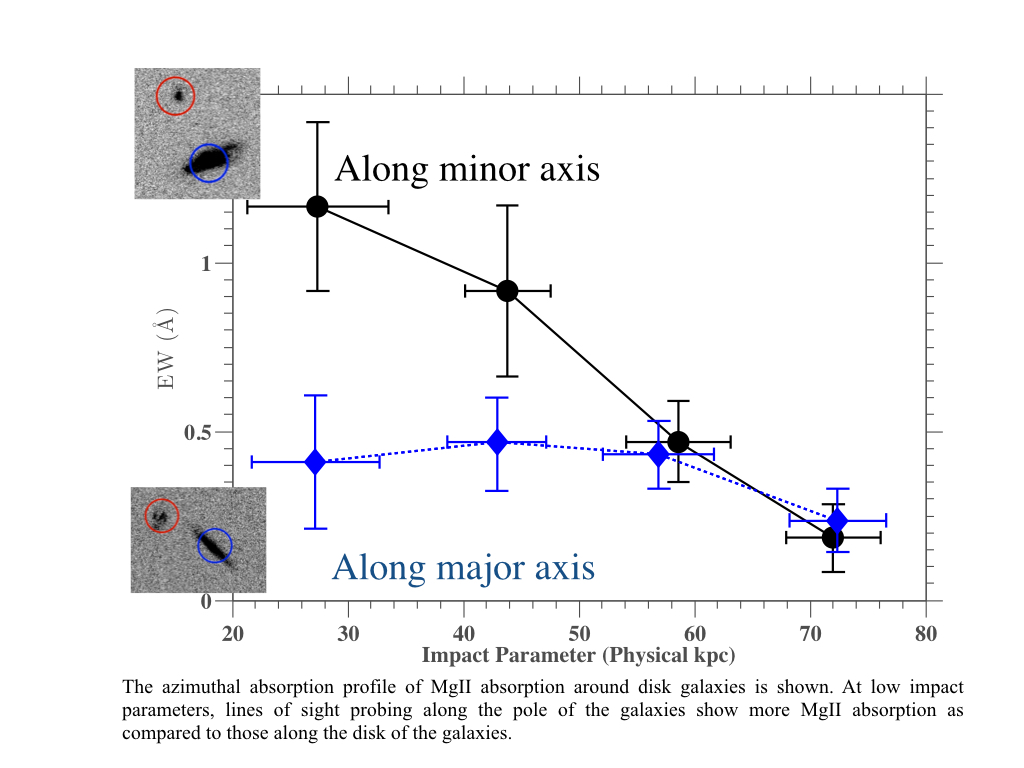
Azimuthal asymmetry: The circumgalactic gas distribution around disk galaxies is strongly asymmetric, revealing bipolar outflow geometries aligned with disk rotation axes—direct evidence of feedback-driven winds.
Dependence on galaxy properties: Circumgalactic gas strength correlates with stellar mass, star formation rate, and galaxy color, demonstrating that galaxies actively regulate their gas halos.
Cooling flows: Highly ionized gas (O VI, N V) traces radiatively cooling flows around galaxies, providing observational evidence for theoretical predictions of gas cooling onto galaxies.
Mapping the 2D Circumgalactic Medium Link to heading
Ground-based spectroscopy of thousands of galaxies reveals the two-dimensional distribution of gas. Using background galaxies and quasars as backlights, we map Mg II absorption around 4000+ low-redshift galaxies, discovering strong azimuthal asymmetries and radial falloff patterns. These observations reveal that circumgalactic gas is not uniformly distributed but organized by feedback and accretion processes.
z ~ 1-3: Cosmic Noon and Spatially-Resolved Gas Dynamics Link to heading
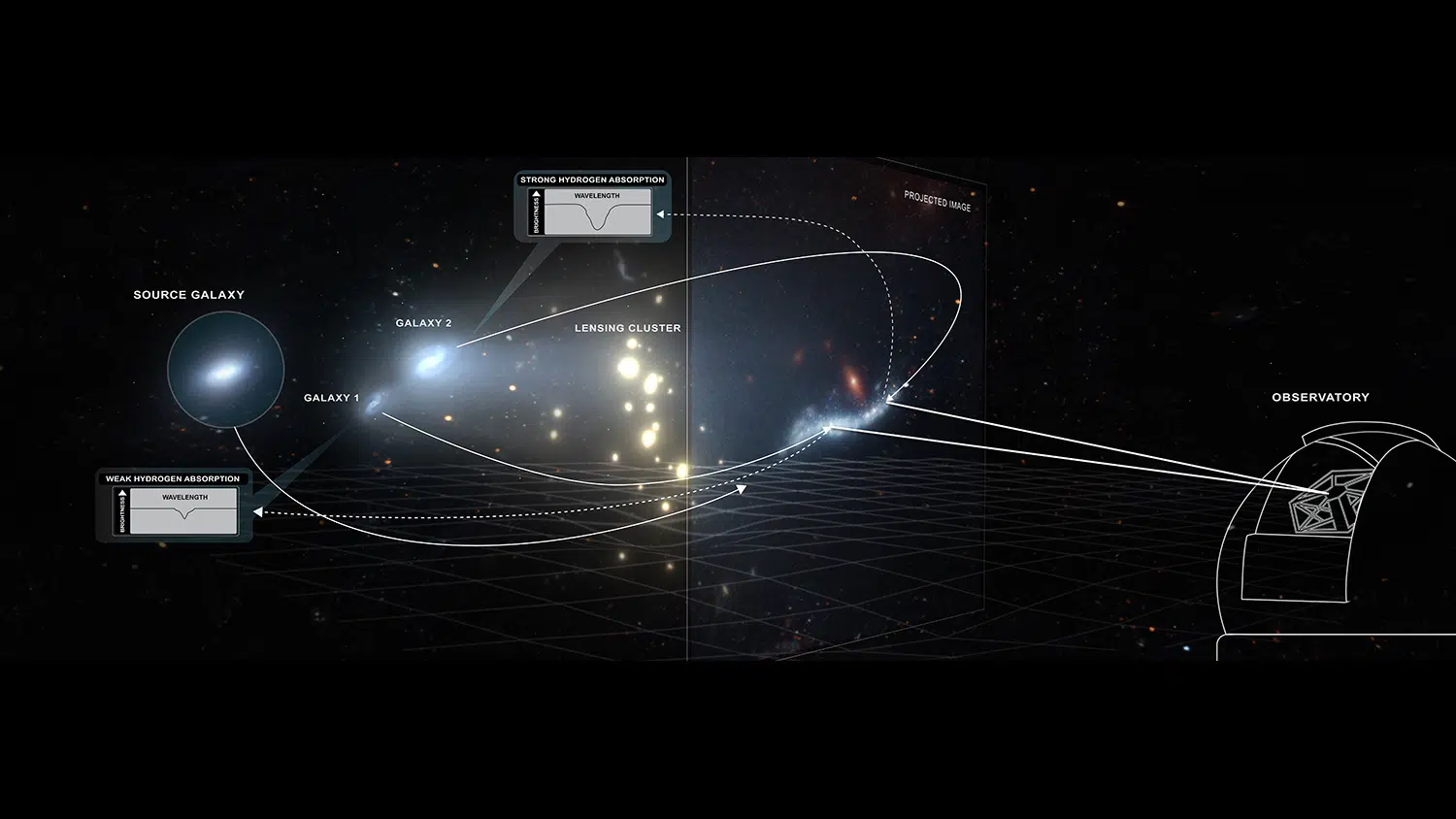
At cosmic noon, galaxies undergo their most intense transformation, with star formation at peak rates and rapid assembly of stellar mass. By combining gravitational lensing with integral field spectroscopy, we resolve circumgalactic gas structure on scales of 100 parsecs—a thousand times smaller than direct observations of unlensed galaxies.
Small-Scale Structure in the Circumgalactic Medium Link to heading
Gravitational lensing magnifies distant galaxies, providing a natural “cosmic telescope” that reveals structures typically invisible to direct observation:
Cloud-scale clumping: Individual clouds of circumgalactic gas are resolved, revealing that gas is not smoothly distributed but clumpy and structured.
Kinematic complexity: Gas flows at multiple velocities, indicating simultaneous infall, outflow, and circulation around galaxies.
Connection to star formation: The small-scale structure of outflows directly traces the underlying star formation distribution, demonstrating that feedback operates locally rather than globally.
Accretion signatures: High-resolution spectroscopy reveals smooth velocity patterns consistent with gas accreting from the cosmic web onto galaxies.
Spatially-Resolved Cold Gas Fueling Star Formation Link to heading
High-resolution studies of damped Lyman alpha systems reveal massive reservoirs of cold, neutral hydrogen concentrated in spatially-resolved structures around galaxies at z ~ 2-3. These observations demonstrate that galaxies at cosmic noon have accumulated enormous masses of cold gas—the fuel for the next generation of stars—ready to power continued star formation and galactic growth.
z > 4-7: Cosmic Dawn and the EIGER Survey Link to heading
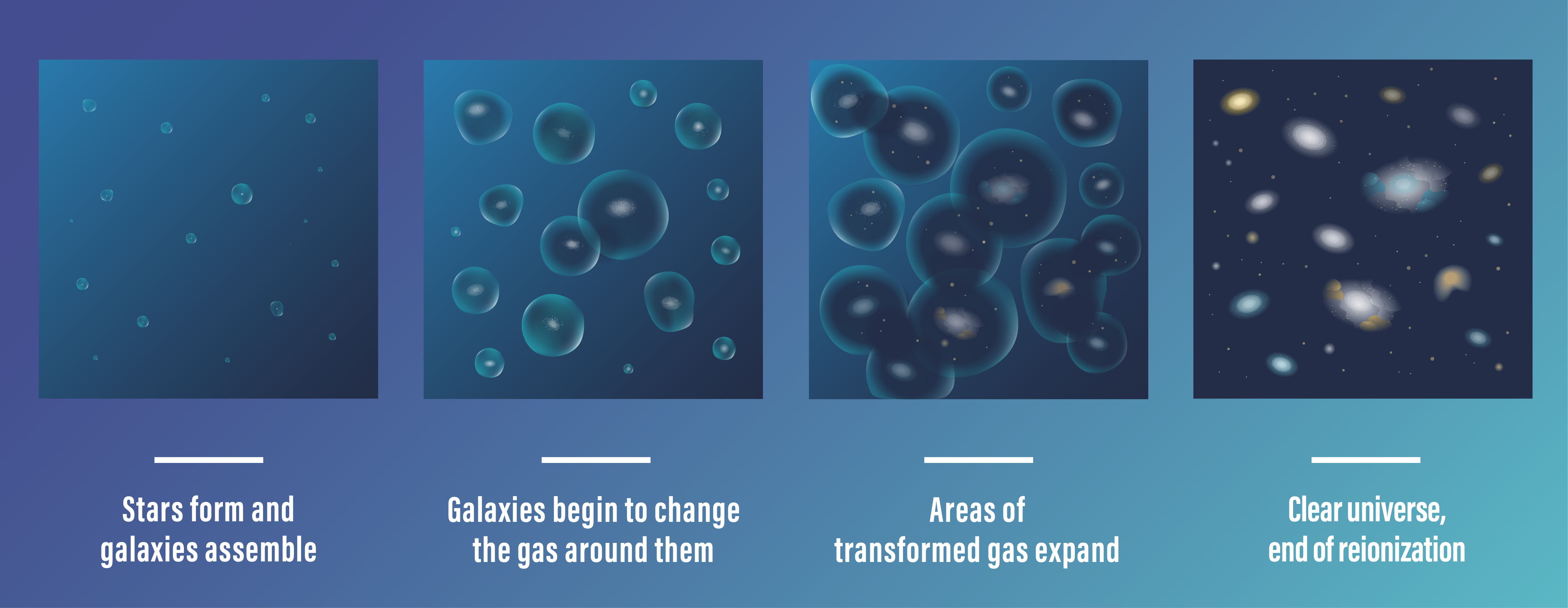
The EIGER survey represents a paradigm shift in how we study early galaxy evolution. Using JWST’s unprecedented infrared sensitivity, we directly observe galaxies in the epoch of reionization (z > 6), revealing their star formation rates, metallicities, and physical properties with exquisite detail. Remarkably, our EIGER observations have even uncovered evidence for Population III stars persisting to z ~ 6, connected to the most massive galaxy overdensities—a finding that revolutionizes our understanding of the earliest stellar populations.
The First Galaxies and Cosmic Reionization Link to heading
Our EIGER results demonstrate that young galaxies efficiently acquire gas from the cosmic web and convert it into stars at remarkably high efficiencies. The survey reveals:
High ionizing photon production: Early galaxies produce sufficient ionizing radiation to drive cosmic reionization, transforming neutral hydrogen into ionized gas throughout the Universe.
Rapid metal enrichment: Despite their youth, these galaxies have already achieved substantial metal enrichment through massive stars and supernovae, demonstrating that nucleosynthesis proceeds rapidly in the early Universe.
Connection to large-scale structure: The spatial distribution of early galaxies closely follows large-scale structure, revealing that galaxies preferentially form in overdense regions.
Star formation efficiency: The conversion of acquired gas into stars proceeds at remarkable efficiency, approaching the cosmic baryon fraction limit.
The Intergalactic Medium at Cosmic Dawn Link to heading
Through absorption spectroscopy, we trace how the intergalactic medium transforms as galaxies reionize it. Metal-enriched gas reveals how early galactic feedback enriches the intergalactic medium, leaving imprints that persist billions of years.
Key Results & Publications Link to heading
EIGER VIII: First Stars Signatures in the Connection Between OI Absorption and Galaxies in the Epoch of Reionization For the first time, detection of Population III star signatures in metal absorption line systems reveals a surprising connection to massive galaxy overdensities at z ~ 6. These discoveries demonstrate that massive primordial stars may have persisted to the epoch of reionization in the outskirts of the most massive structures—a striking finding that challenges our understanding of the earliest stellar populations and suggests Population III stars played a direct role in creating the cosmic ionizing background that reionized the universe. Higginson et al. 2025 - ApJ submitted
EIGER VII: The Evolving Relationship Between Galaxies and the Intergalactic Medium in the Final Stages of Reionization Tracing the connection between galaxies and the surrounding intergalactic medium during cosmic reionization reveals how early galaxies transform their environment and regulate large-scale structure. Kashino et al. 2025 - ApJ in press
EIGER IV: The Cool Circumgalactic Medium of High-z Galaxies Reveals Remarkably Efficient IGM Enrichment Observations of 29 distant galaxies at z = 2.3–6.3 reveal that cool circumgalactic gas extends far beyond galaxy virial radii with high kinematic velocities (median ~135 km/s), indicating that early galaxy halos are in a state of remarkable disequilibrium and efficiently enrich the intergalactic medium with metals. Bordoloi et al. 2024 - ApJ, 963, 28
EIGER II: First Spectroscopic Characterization of Young Stars and Ionized Gas in [O III]-Emitting Galaxies at z = 5-7 JWST spectroscopy of 117 [O III]-emitting galaxies reveals extremely high equivalent widths (≈850 Å, up to 3000 Å) and a strong mass-metallicity relation in dust- and metal-poor early galaxies. The [O III] luminosity density at z ≈ 6 significantly exceeds lower redshifts, demonstrating that emission-line surveys with JWST efficiently trace the galaxy density during the Epoch of Reionization. Matthee et al. 2023 - ApJ, 950, 67
EIGER I: A Large Sample of [O III]-Emitting Galaxies at 5.3 < z < 6.9 and Direct Evidence for Local Reionization by Galaxies Analysis of 117 emission-line galaxies detected by JWST reveals prominent galaxy overdensities and distance-dependent IGM transmission patterns. The findings provide direct evidence that local ionizing radiation from galaxies dominates over the cosmic background during reionization, confirming that galaxies played a crucial role in ionizing the intergalactic medium. Kashino et al. 2023 - ApJ, 950, 66
Compact [C II] Emitters Around a C IV Absorption Complex at Redshift 5.7 Detection of compact [C II]-emitting galaxies clustered around a massive C IV absorption system reveals the connection between massive gas-rich structures and sites of intense star formation during the epoch of reionization. This discovery provides direct evidence for how circumgalactic gas reservoirs fuel star formation in the earliest galaxies and shape the structure of the intergalactic medium. Kashino et al. 2023 - Nature, 617, 261–264
Resolving the H I in Damped Lyman α Systems That Power Star Formation Using integral field spectroscopy and gravitational lensing, we resolve the cold gas supplying star formation in distant galaxies, revealing how accretion flows feed galactic disks. Bordoloi et al. 2022 - Nature, 606, 59–63
On the CGM Fundamental Plane: The Halo Mass Dependency of Circumgalactic HI High-resolution observations reveal the fundamental relationship between halo mass and the distribution and kinematics of circumgalactic neutral hydrogen, constraining how galaxies acquire and cycle gas. Bordoloi et al. 2018
The COS-Dwarfs Survey: Carbon Reservoir Around Sub-Lstar Galaxies The COS-Dwarfs survey maps the circumgalactic medium of 43 low-mass galaxies, revealing that carbon (C IV) extends to ~100 kpc from host galaxies. The carbon mass in the circumgalactic medium (>1.2 × 10⁶ M☉) exceeds that locked in stellar populations, demonstrating that low-mass galaxies maintain substantial gas reservoirs essential for star formation. Bordoloi et al. 2014
The Radial and Azimuthal Profiles of Mg II Absorption Around 0.5 < z < 0.9 zCOSMOS Galaxies Mapping the 2D distribution of cool gas around low-redshift galaxies reveals strong azimuthal asymmetries, demonstrating bipolar outflow geometries aligned with disk rotation axes. These observations provide direct evidence for feedback-driven winds sculpting the circumgalactic medium. Bordoloi et al. 2011
The Team Link to heading
This research involves a large, collaborative team with expertise spanning JWST observations, spectroscopy, numerical simulations, and data analysis. We work with colleagues at leading universities and observatories worldwide, mentoring graduate and undergraduate students in research at the frontier of galaxy evolution studies.
Related Resources Link to heading
- EIGER Survey Website — JWST observations of the epoch of reionization
- Circumgalactic Medium Research Page — Gas reservoirs around galaxies at all redshifts
- Observing with JWST Research Page — JWST observations and techniques
- Main Research Overview — Summary of all research areas