The Fermi Bubbles Link to heading
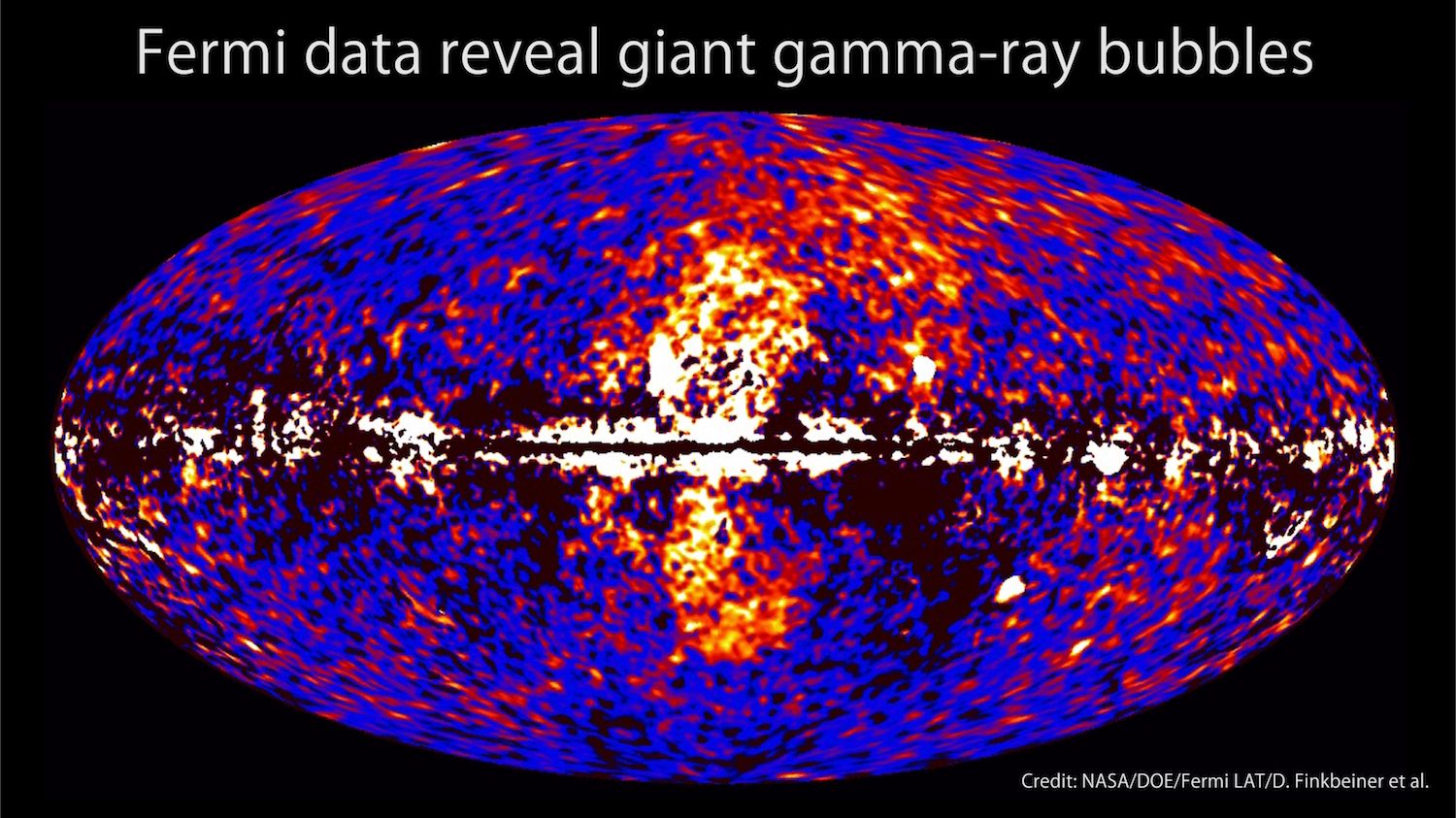
The Fermi Bubbles are the smoking gun of the Milky Way’s violent past—two colossal lobes of plasma extending 55,000 light-years above and below our Galactic Center. These structures reveal a cataclysmic explosion that erupted from the supermassive black hole at the galaxy’s heart, reshaping the entire halo of our galaxy. Through a long-running observational program, we use Hubble Space Telescope UV spectroscopy combined with radio observations from the Green Bank Telescope to measure the age, energy, and momentum of this cosmic explosion—revealing the physical mechanism driving some of the most powerful feedback events in the universe. We have recently been awarded over 200 hours of Green Bank Telescope time (PI Bordoloi) to map the hidden population of neutral hydrogen gas entrained at high latitudes within the Fermi Bubbles, providing unprecedented constraints on the cold gas distribution and survival mechanisms.
Some of my recent work on this field are listed below.
Discovery of a new population of 21-cm high-velocity clouds in the Galactic Center region Link to heading
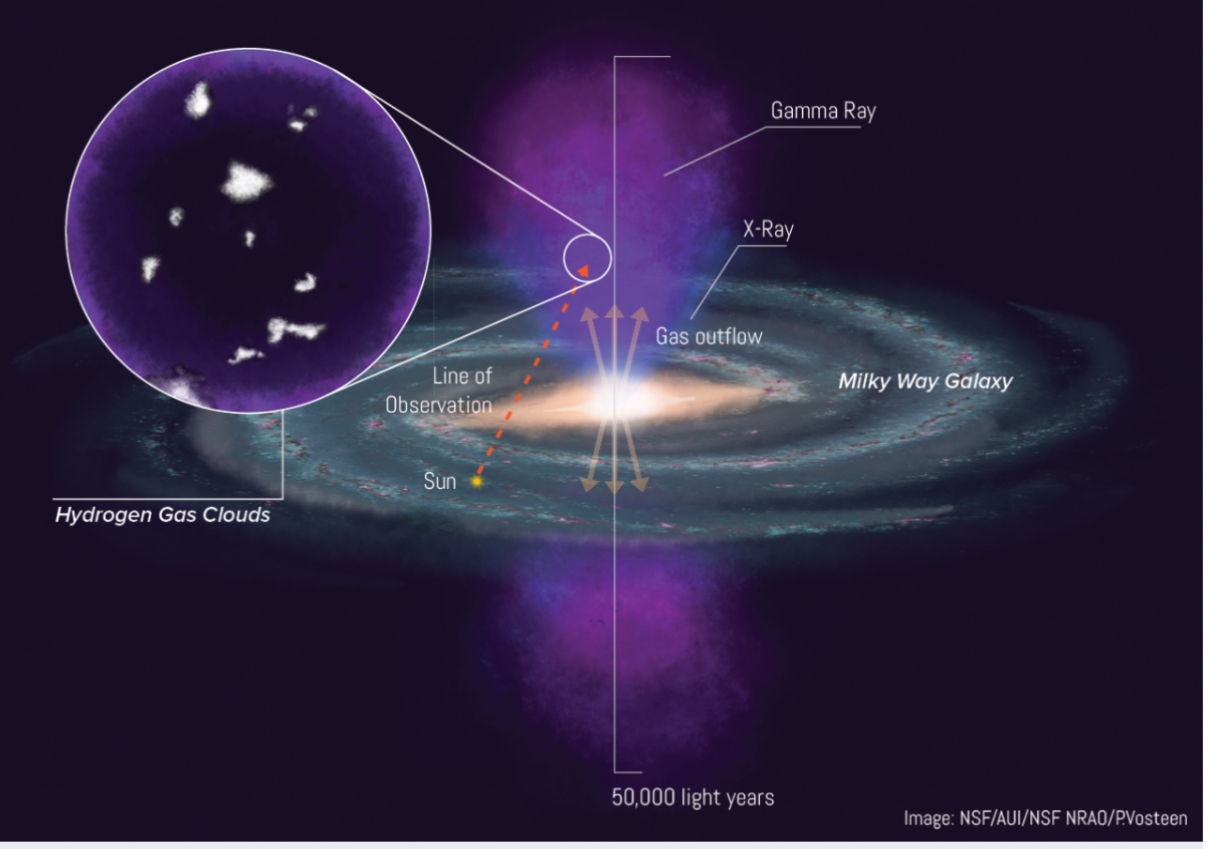
We performed deep 21-cm radio observations with the the Green Bank Telescope (GBT) towards the center of the northern Fermi Bubbles and discovered a large population of cold, neutral-hydrogen “clouds” — surviving deep inside the hot, superheated Fermi Bubbles of our Galaxy, more than 13,000 light-years above the Milky Way’s center.
This is surprising because the Bubbles are filled with plasma exceeding a million Kelvin, and such cold clouds should have evaporated or been destroyed — yet they appear structured, dynamic, and long-lived (millions of years).
Their survival suggests that the Fermi Bubbles are younger than previously believed, likely formed by a relatively recent outburst from the Galaxy’s central black hole rather than slower, long-term processes. This discovery challenges existing models of galactic outflows and opens new questions about how cold gas can persist — and what that means for the life cycle of matter in galaxies. For more information see Bordoloi et al. 2025.
Mapping the Nuclear Outflow of the Milky Way: Studying the Kinematics and Spatial Extent of the Northern Fermi Bubble: Link to heading
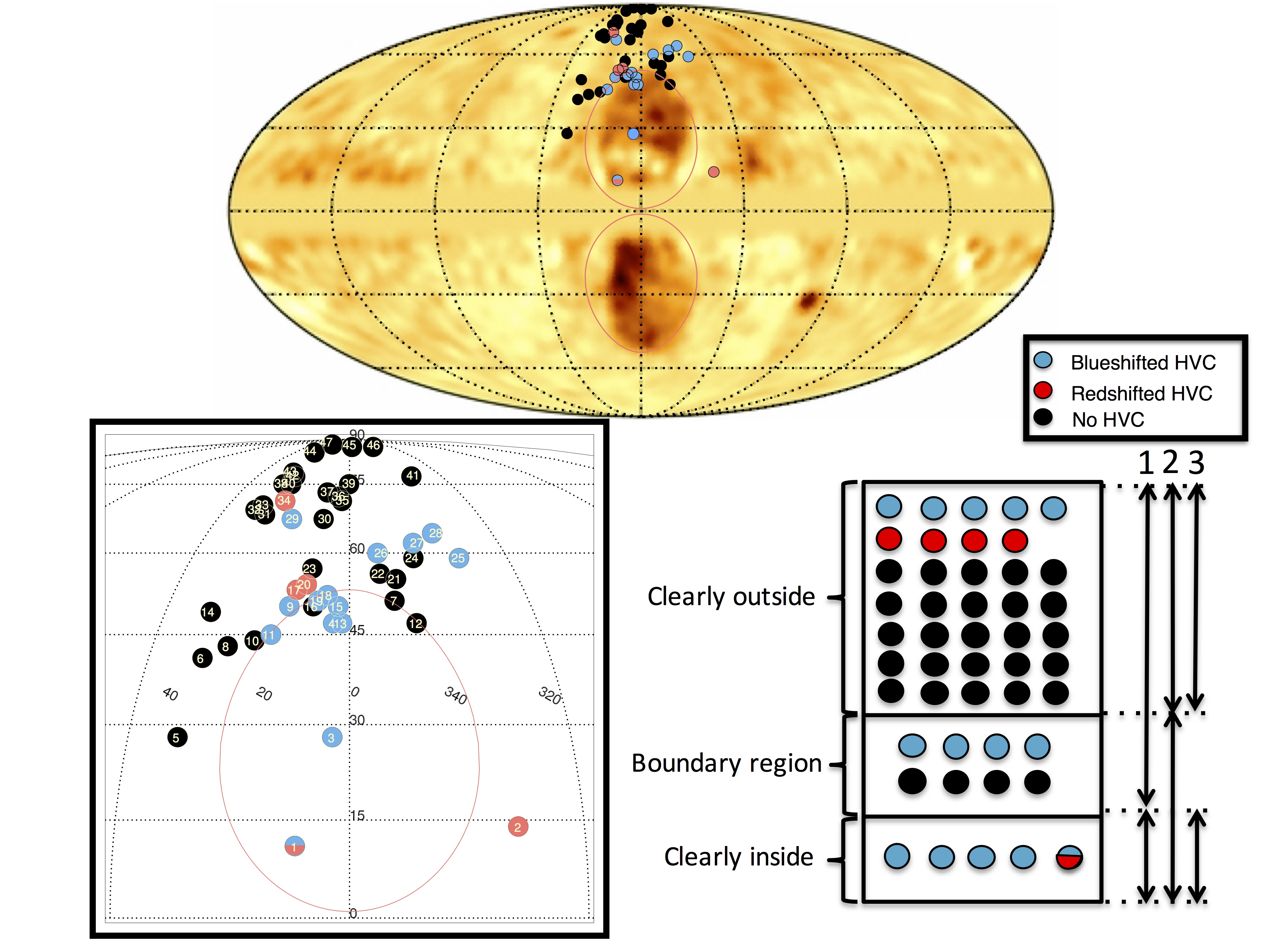
Recent observations of gamma rays together with microwaves and polarized radio waves, have detected giant lobes of plasma (Fermi Bubbles) extending above and below the Galactic plane of the Milky Way. These are possible signs of a Nuclear wind powered by either the central black hole or concentrated nuclear star-formation; but our understanding of their origin is hampered by a lack of kinematic information. In this work, we use ultraviolet spectra of 47 background QSOs and halo stars projected inside and outside the northern Fermi Bubble from the Hubble Space Telescope to study the incidence of high velocity absorption around it. We use five lines of sight inside the northern Fermi Bubble to constrain the velocity and column densities of outflowing gas traced by O I, Al II, C II, C IV, Si II, Si III, Si IV and other species. We find that all five lines of sight inside the northern Fermi Bubble exhibit blueshifted high velocity absorption components, whereas only 9 out of the 42 lines of sight outside the northern Fermi Bubble exhibit blueshifted high velocity absorption components. The observed outflow velocity profile decreases with Galactic latitude and radial distance (R) from the Galactic Center. The observed blueshifted velocities change from v_GSR = -265 km/s at R ~ 2.3 kpc to v_GSR = -91 km/s at R ~ 6.5 kpc. We derive the metallicity of the entrained gas along the 1H1613-097 sightline, one that passes through the center of the northern Fermi Bubble, finding [O/H] > -0.54 +- 0.15. A simple kinematic model tuned to match the observed absorption component velocities along the five lines of sight inside the Bubble, constrains the outflow velocities to ~ 1000-1300 km/s, and the age of the outflow to be ~ 6-9 Myr. We estimate a minimum mass outflow rate for the nuclear outflow to be > 0.2 Solar mass/Year. Combining the age and mass outflow rates, we determine a minimum mass of total UV absorbing cool gas entrained in the Fermi Bubbles to be > a few million Solar masses. These observations illustrate the novel use of UV spectroscopy to constrain the feedback processes that regulate galaxy evolution. For more information see Bordoloi et al. 2017.
Probing the Fermi Bubbles in Ultraviolet Absorption: A Spectroscopic Signature of the Milky Way’s Biconical Nuclear Outflow: Link to heading
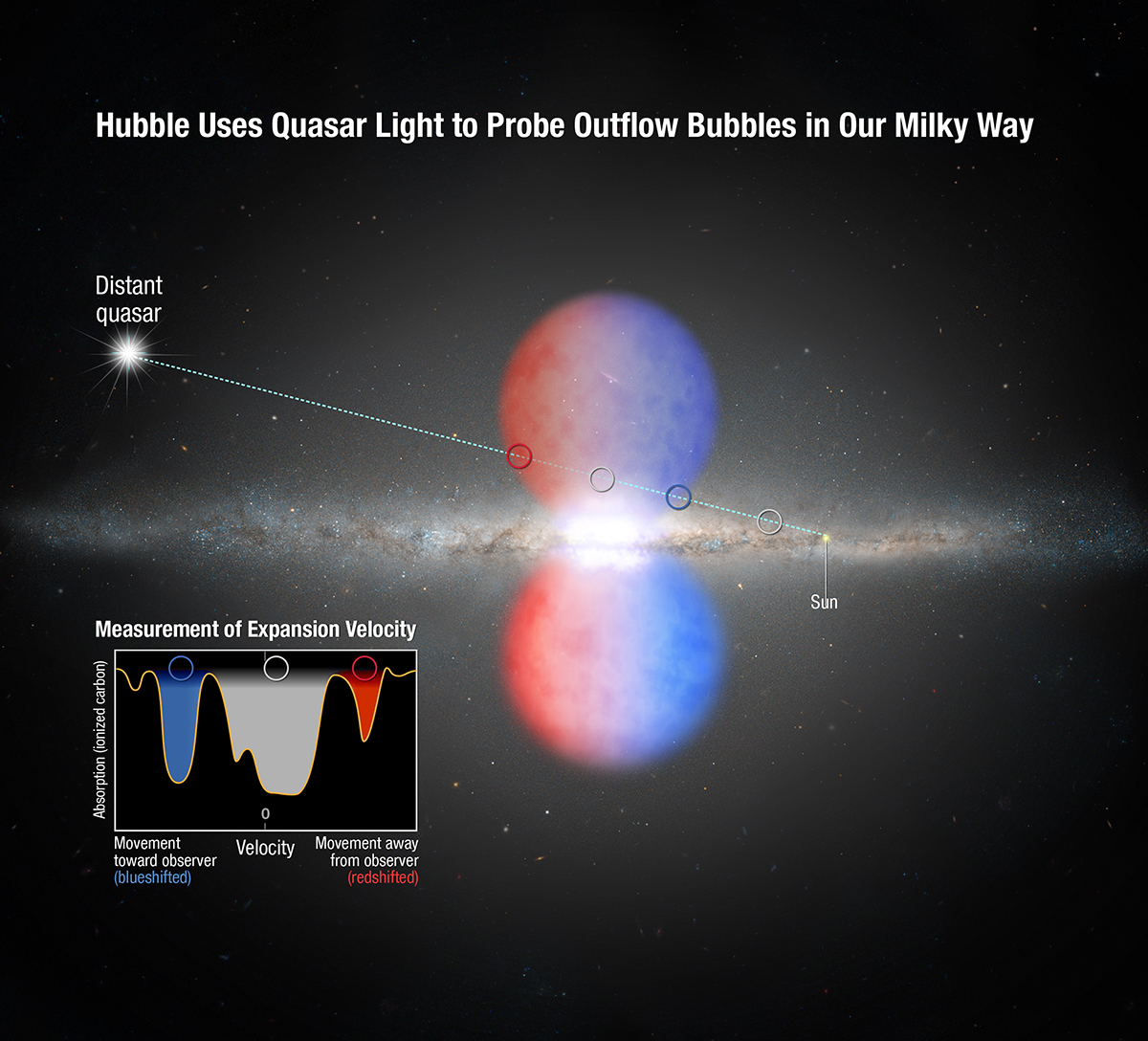
Giant lobes of plasma extend ≈55° above and below the Galactic center, glowing in emission from gamma rays (the Fermi Bubbles) to microwaves and polarized radio waves. We use ultraviolet absorption-line spectra from the Hubble Space Telescope to constrain the velocity of the outflowing gas within these regions, targeting the quasar PDS 456 (l, b = 10.°4, +11.°2). This sightline passes through a clear biconical structure seen in hard X-ray and gamma-ray emission near the base of the northern Fermi Bubble. We report two high-velocity metal absorption components, at v LSR = -235 and +250 km/s, which cannot be explained by co-rotating gas in the Galactic disk or halo. Their velocities are suggestive of an origin on the front and back side of an expanding biconical outflow emanating from the Galactic center. We develop simple kinematic biconical outflow models that can explain the observed profiles with an outflow velocity of ~ 1000 km/s and a full opening angle of ≈110° (matching the X-ray bicone). The observations illustrate the use of UV spectroscopy to probe the properties of swept-up gas venting into the Fermi Bubbles. For more information see Fox et al. 2015.
Key Results & Publications Link to heading
A New High-latitude H I Cloud Complex Entrained in the Northern Fermi Bubble Discovery of a new population of cold, neutral-hydrogen clouds surviving inside the hot Fermi Bubbles, with implications for the age and dynamics of the nuclear outflow. Bordoloi et al. 2025
Probing the Fermi Bubbles in Ultraviolet Absorption: A Spectroscopic Signature of the Milky Way’s Biconical Nuclear Outflow High-velocity metal absorption components reveal a biconical outflow structure with ~1000 km/s velocities and an opening angle of ~110°, matching hard X-ray observations. Fox et al. 2015
Mapping the Nuclear Outflow of the Milky Way: Studying the Kinematics and Spatial Extent of the Northern Fermi Bubble UV spectroscopy of 47 background quasars constrains the outflow age to 6-9 Myr, outflow velocities to ~1000-1300 km/s, and estimates millions of solar masses of cool gas entrained in the Bubbles. Bordoloi et al. 2017
Diverse metallicities of Fermi bubble clouds indicate dual origins in the disk and halo Analysis of metallicity distributions reveals that Fermi Bubble clouds originate from both the Galactic disk and halo, providing constraints on the outflow mechanism and composition. Ashley et al. 2022